IceCube Overview
IceCube
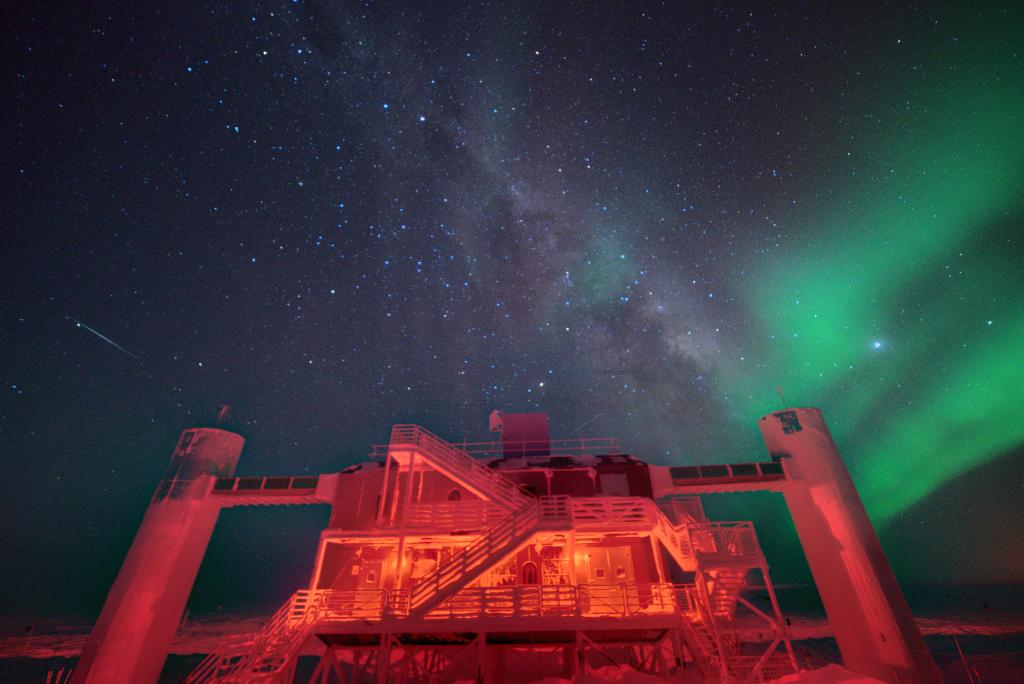
IceCube is a cubic kilometer of instrumented ice near Amundsen-Scott South Pole Station. You can find the official webpage here. In the detector, neutrinos interact with the ice to produce charged particles which leave tracks of light. This light is picked up by specialized photodetectors called Photomultiplier Tubes (PMTs) inside of thick glass spheres known as Digital Optical Modules (DOMs).

By piecing together each hit on each DOM, we can reconstruct the direction and energy of the incoming particle. There are 3 major sources of incoming particles: Atmospheric muons, atmospheric neutrinos, and astrophysical neutrinos. Atmospheric muons are almost always a background, and a detector at the surface of the ice is used to veto them. Atmospheric neutrinos are useful for measuring particle properties (The side of IceCube with which I am most involved), and Astrophysical neutrinos are useful for neutrino astronomy. You might have seen IceCube in the news recently:


The left is the first observation of an astrophysical neutrino, while the right is the first neutrino that was identified as from a specific source. The source was identified by coincidence with photon flaring. Since the blazar was found, IceCube has seen an active galactic nucleus, and has, as of 2023, seen the Milky Way.
 Turation